Peer review
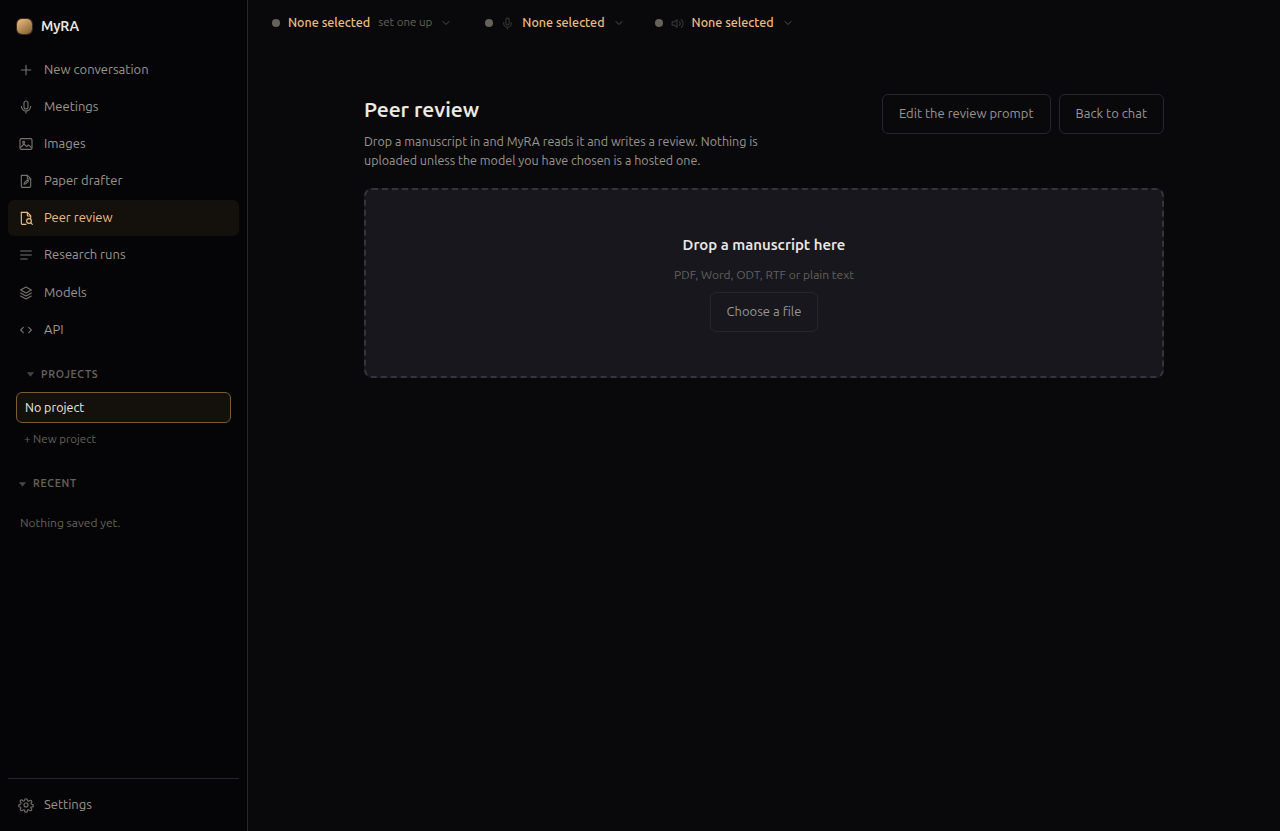
Drop in a manuscript you’ve been asked to review, and MyRA writes a panel’s worth of reports on it.
The panel
Three reviewers, each asked separately rather than in one combined request — which is closer to how a journal actually works, and keeps each request small. Their prompts share most of their text (house rules against inventing literature, reporting citations rather than repairing them) but differ in what each one is actually looking for — a statistician’s read on an experiment, a PRISMA 2020 checklist on a systematic review, and so on depending on the study design.
A reviewer that returns nothing has its failure filed under its own heading rather than silently dropped — if two of three reviewers respond, you keep those two.
Editable prompts
Unlike the paper drafter, these prompts are editable — a reviewer’s standards are their own, and journals differ. The rule against inventing literature is stated in the prompt text itself, where you can read it, rather than hidden somewhere it can’t be changed. Click Edit the review prompt to see and change it.
What happens to the manuscript
The manuscript is never written to disk. It’s read directly as bytes when you drop it in, held in memory for the length of the review, and discarded afterward — it’s somebody else’s unpublished work, and MyRA never even learns the file’s original path on your machine. Only the finished review is kept.
If a manuscript is too long for the model you’ve chosen, MyRA refuses rather than silently truncating it — a review that quietly stops partway through the major concerns is worse than one that says up front it can’t be done with the current model.