Paper drafter
The paper drafter turns raw, half-formed notes into first-draft academic prose in your own voice — not a generic model voice.
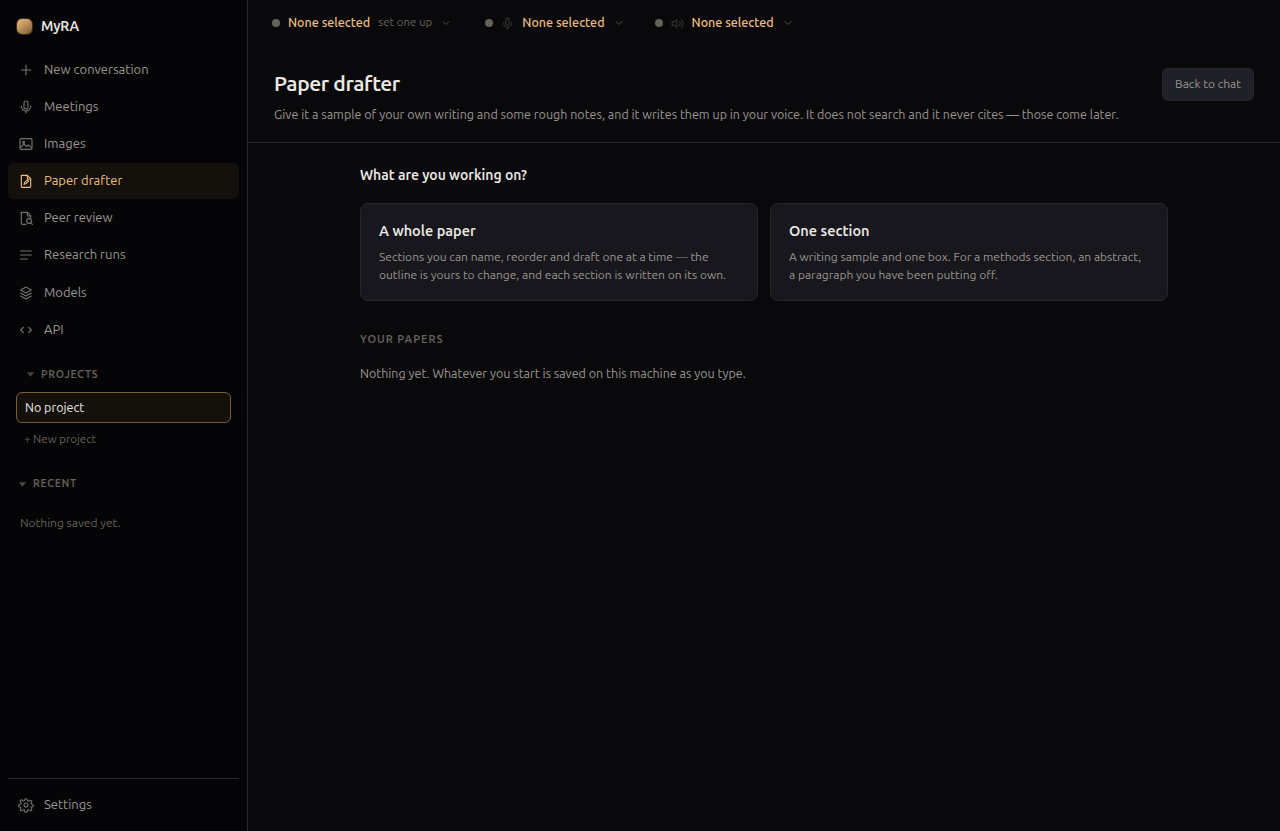
How it works
- Paste a sample of your own writing.
- Under each heading, jot or dictate what you want that section to say — notes, not prose.
- Each section is drafted on its own, using your sample to match voice.
Work on a whole paper — sections you name, reorder, and draft one at a time, with the outline entirely yours to change — or one section, for a methods paragraph or an abstract you’ve been putting off.
What it deliberately does not do
The paper drafter does not search, and it never cites. The prompt forbids references, placeholders, and invented sources outright — and if anything citation-shaped shows up anyway, it’s flagged rather than quietly removed. Citations come from Research or your own editing afterward; mixing that job into drafting is exactly how a model ends up inventing a source that sounds plausible.
Starting from a project’s notes
Drafting inside a research project with notes of its own adds a + From project notes button, which copies your settled questions, aims, theory, methods, and decisions — never key literature, since the drafter forbids citations — straight into the instructions box, where the preview shows exactly what went in.
What’s sent, and when
Drafting a section sends the section you asked for — your writing sample, your notes, and your instructions — to whichever model you’ve chosen, and nothing else. A local model means it never leaves this machine. The prompt preview shows exactly what would be sent before you send it, and showing the preview sends nothing itself.
Everything you write is saved on this machine as you type.